
For artists Krõõt Juurak and Alex Bailey, becoming parents in 2017 marked not only a life change but the beginning of a new form of artistic collaboration. This moment sparked CODOMESTICATION, a family performance in which children do not simply appear on stage – they direct the adults, shaping the performance in real time.
CODOMESTICATION is one of the artistic works touring as part of (M)others on Tour, a wider project initiated by artist Renata Piotrowska-Auffret dedicated to artists with parenting responsibilities, which addresses the systemic challenges they face in the performing arts. Through an inventive ‘showing without going’ model, CODOMESTICATION travelled across Europe without the artists themselves touring, instead being passed on to local families who bring the piece to life.
In this interview, Krõõt Juurak, an Estonian artist and performer and co-creator of CODOMESTICATION, reflects on how parenting became a creative force, how children disrupt traditional hierarchies on stage, what it was like to see the performance reshaped by local families, and what this new touring model might mean for the future of touring.
Take us back to the moment CODOMESTICATION began. When did you first sense that your relationship with your child could become more than daily life and evolve into an artistic collaboration?
As contemporary artists and performers, we are all accustomed to project-based work. For the past two decades, I have been a freelance artist, moving from one project to the next. So, when my child was born in 2017, it initially felt very much as though this, too, was the start of a new project.
Spending time with a newborn baby resembled a kind of artistic residency, and meeting the baby resembled meeting a new colleague who has begun to direct our lives, our time and our energy. As parents, we learnt a whole new set of skills to fulfil the wishes of our newborn, all the while seeing the world anew, as though through the eyes of this new colleague – observing things together, going to places, imagining things, playing, and being present.
And so, a few months later, when I was writing the application for a new project, I realised that it would be an interesting idea to continue this process towards a collaborative performance. So, we decided to invite our child into the project, now called CODOMESTICATION, as an artistic collaborator.
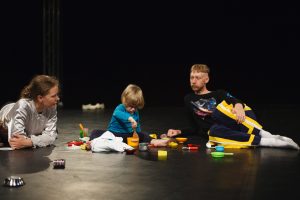
Original performance of CODOMESTICATION, Krõõt Juurak & Alex Bailey, CNDB Bucharest 2019, ©Vlad Brăteanu
In your artistic work, you’ve embraced the unpredictability of children as a source of creativity. What have you learned from this approach as an artist?
What is inspiring for me is the way a child is not so bothered about rules and regulations – both written and the unwritten rules, or in general, the habits, patterns and taboos of the art world.
I have learned to focus more on exploring and less on results. I have observed how committed children are to their desires – this is very important to me as an artist as well. I have learnt that there is no limit to how much one can enjoy work and play. Grown-ups often worry too much, and that is usually not helpful for a good work nor for a good life. So, it is a really good idea to look at our children and learn.
The piece gives children real decision-making power on stage. How does this influence the dynamics of the performance and the way audiences experience it when adults and children collaborate as equals?
Due to the asymmetry of power between adults and children, I have even taken this score further, so the game is that adults are the performers and children take on the role of the directors of the piece. Both the ‘director(s)’ and ‘performers’ are on stage, but the parents’ or caregivers’ job is to be ‘performer’s for their children – to assist and perform what their children want the piece to be.
How the audience experiences this is of course individual; however, when I saw the show, my experience of the children was that they were very smart, present, and naturally more attentive than their parents. This gave me a feeling of compassion for the adults, who are professional performers and are really trying their best, but they cannot really compete with a child in how present they are on stage.
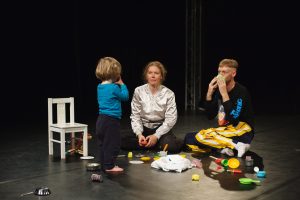
Original performance of CODOMESTICATION, Krõõt Juurak & Alex Bailey, CNDB Bucharest 2019, ©Vlad Brăteanu
Usually, artists on tour perform their own works. In your case, you co-created and performed the original piece, yet CODOMESTICATION now travels through others – a process called ‘showing without going’. What has this approach been like for you, both as an artist and as a parent?
I feel that this has really expanded the work. CODOMESTICATION is now not only about the individuals who perform it, but rather, about how the touring concept shows humanity in a very specific way. I feel that this is even better than its original performance. In a way, the limitation of not being able to work with the performers in person allowed me to entrust them with the work and let them re-create it quite autonomously. They were able to make the work really their own, and this is quite important for a good performance. And as a parent of a school child – ‘showing without going’ has made it possible for me to tour my work again, which I am so happy about!
When you saw CODOMESTICATION performed in Warsaw by another family, what was that experience like? Did it reveal anything new or unexpected about the work itself?
I greatly enjoyed the performance by Iza Szostak and her family. I was surprised and touched by how much more there was to see in this piece than I had even imagined. I understood that this performance is not only about families but also about the fragility of emotions and intention – how vulnerable and beautiful individuals can be when they are busy just being themselves. So, I’m very happy I got the chance to see that!
| CODOMESTICATION reinterpreted by a local family in Warsaw, premiered at OKO – Ośrodek Kultury Ochoty. |
Many artists struggle to balance parenthood with the demands of performance-making and touring. What systemic challenges have you observed for parents in the performing arts and how does (M)others on Tour address or reflect these issues?
I have noticed that being a parent is somehow still generally considered a limitation. The art field is fitting for people without children. And so we still need to either explain and excuse ourselves or stay quiet and pretend that everything is ok. This makes the balance even harder to achieve.
(M)others on Tour is one of the most generous concepts for parents I have yet come across – where I have not even once had the feeling that being a parent was a limitation. It would be great if this was more common!
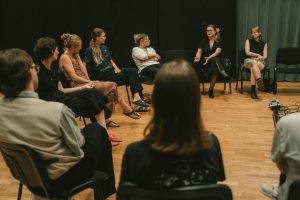
Krõõt Juurak (fourth from the left) participating in a workshop in Warsaw, © (M)others on Tour
You’ve said that the creativity of children and ‘others’ inspires you, as it can disrupt established ways of working. What possibilities do you see for this kind of openness and disruption within the wider performing arts community today?
I see that in the creative field, limitations can be approached as opportunities and, therefore, we, instead of trying to pretend that these limitations aren’t there, can see them as opportunities for other ways of working.
So, indeed, having children comes with a lot of limitations in terms of time and resources, but it also comes with a whole new set of opportunities that can bring new ways of creating, performing and observing. I feel like too many artists are trying too hard to continue working as they did before they had children – to fit into the establishment – which is simply exhausting. Instead, we, artists with children, can make the establishment fit us.
Having children is the perfect excuse to re-invent our working environment.
Now that CODOMESTICATION lives through other families across Europe, how has the work evolved? Has it changed shape or perhaps revealed something new about what touring can mean today?
I feel like this concept could be shared with any family. It is now a little like a family photo, only in the medium of performance. So instead of a photograph, we have the family performing themselves on stage. As a result of being performed across different countries and families in Europe, CODOMESTICATION is now not about just one family but about any family.
Letting a work spread in this way not only changes what touring can mean but also how a choreographer or a theatre director can transmit the work, where instead of simply trying to reproduce the same work, we can let it evolve through the tour.
I feel like ‘showing without going’ could become a mainstream method of touring works. It just makes sense that instead of companies flying around the world, it is the concepts that fly. It’s good for the environment. It’s also empowering for the local communities and a creative challenge for directors.

Local adaptations of CODOMESTICATION in Poland, Italy, Denmark and North Macedonia, © (M)others on Tour
As part of the Perform Europe tour, CODOMESTICATION travelled through Italy, Poland, Denmark and North Macedonia, with each performance reshaped by the families who brought it to life.
Within (M)others on Tour, the work turned the practical limits of parenthood into a collaborative and evolving touring concept. By being reimagined in each new context, it points to a future where touring does not rely on constant travel and where performances can grow and change as they move. In doing so, the project offers more than an alternative touring model – it proposes a rebalancing of how art is shared and sustained.

